
16 KiB
I’m sharing this because I think your architecture‑moat ambitions for Stella Ops map really well onto what’s already emerging in SBOM/VEX + call‑graph / contextual‑analysis tooling — and you could use those ideas to shape Stella Ops’ “policy + proof‑market” features.


✅ What SBOM↔VEX + Reachability / Call‑Path Tools Already Offer
- The combination of Snyk’s “reachability analysis” and Vulnerability Exploitability eXchange (VEX) lets you label each reported vulnerability as REACHABLE / NO PATH FOUND / NOT APPLICABLE, based on static call‑graph (or AI‑enhanced analysis) of your actual application code rather than just “this library version has a CVE.” (Snyk User Docs)
- If reachable, Snyk even provides a “call‑path” view showing how your code leads to the vulnerable element — giving a human-readable trace from your own functions/modules into the vulnerable dependency. (Snyk User Docs)
- The VEX model (as defined e.g. in CycloneDX) is designed to let you embed exploitability/ context‑specific data alongside a standard SBOM. That way, you don’t just convey “what components are present,” but “which known vulnerabilities actually matter in this build or environment.” (CycloneDX)
In short: SBOM → alerts many potential CVEs. SBOM + VEX + Reachability/Call‑path → highlights only those with an actual path from your code — drastically reducing noise and focusing remediation where it matters.
🔧 What Artefact‑ or Container‑Level “Contextual Analysis” Adds (Triage + Proof Trail)
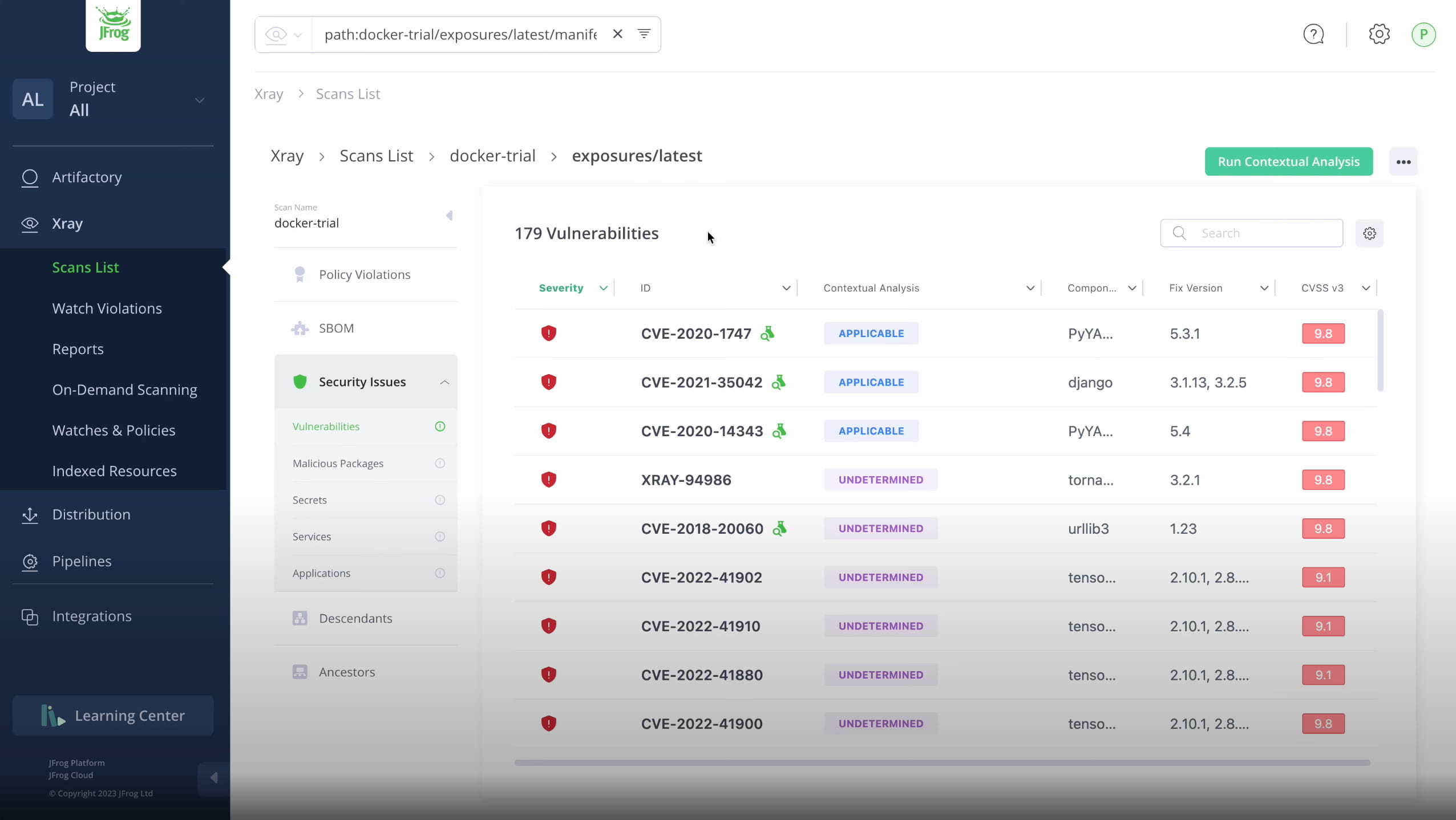
- JFrog Xray’s “Contextual Analysis” (when used on container images or binary artifacts) goes beyond “is the library present” — it tries to reason whether the vulnerable code is even invoked / relevant in this build. If not, it marks the CVE as “not exploitable / not applicable.” That dramatically reduces false positives: in one study JFrog found ~78% of reported CVEs in popular DockerHub images were not actually exploitable. (JFrog)
- Contextual Analysis includes a call‑graph view (direct vs transitive calls), highlights affected files/functions & line numbers, and lets you copy details for remediation or auditing. (JFrog)
- Combined with SBOM/VEX metadata, this enables a full proof trail: you can track from “component in SBOM” → “vulnerability discovered” → “reachable from my code or image” → “call‑path evidence” → “justified exploitability status.” That makes your SBOM/VEX data actionable and auditable without manual spreadsheets or email threads. (Endor Labs)
🎯 Why This Matters for Stella Ops’ Moats
Given your ambitious Stella Ops design — deterministic scans, reproducible proofs, cryptographically verifiable supply‑chain attestations — this established workflow model is a very powerful blueprint:
- You could integrate call‑graph reachability + artifact‑level contextual analysis directly into your “Proof‑of‑Integrity Graph,” giving customers a clear, machine‑readable + human‑auditable exploitability verdict per vulnerability.
- The “one‑click evidence” model (call‑path + signed SBOM/VEX + transparency‑log index) maps neatly onto your planned Proof‑Market Ledger / “trust‑credit” economy: consumers see not just “vulnerable component included,” but “here’s the exact evidence proving it is or isn’t reachable/exploitable.”
- It also supports tiered remediation prioritization (e.g. reachable + high severity + business‑critical vs unreachable / low‑impact), reducing burden on teams just like Snyk and JFrog do for their customers.
🧑💻 What’s Still Missing / What You Should Improve
- Reachability analysis — especially static — is not perfect: “NO PATH FOUND” doesn’t guarantee “never exploitable.” Reflection, dynamic loading, environment‑specific behavior can cause false negatives. (Snyk User Docs)
- VEX annotations often remain semi‑manual or vendor‑supplied — but for a fully trust‑worthy "Proof‑Market," you’ll need automated generation + strong signing + revocation / update mechanisms (which seems aligned with what you planned).
- For containerized builds, the contextual analysis must tie SBOM entries to actual runtime/packaged artifacts — your deterministic rebuild + binary lineage + transparency‑log approach could help guarantee that.
I think combining SBOM + VEX + reachability/call‑path + artifact‑level contextual analysis gives a real, operational model that matches what you envision for Stella Ops — but with some limitations that your added layers (cryptographic signing, replayability, trust‑market) can uniquely address.
If you like — I can sketch a minimal architecture (modules & data flow) that implements exactly that model in Stella Ops (call‑graph analyzer → VEX annotator → signed bundle → ledger entry).
Stella Ops’ big advantage can be: turn “security findings” into “verifiable claims with evidence”—portable across org boundaries, continuously updateable, and audit-friendly—by combining SBOM + VEX + reachability/call-path + signed provenance into one evidence graph.
Stella Ops advantages (what becomes uniquely hard to copy)
1) Actionable vulnerability truth, not CVE spam
SBOMs tell you what’s present; VEX tells you whether a known vuln matters in your specific context (affected vs not_affected vs fixed vs under_investigation), which is the difference between “alert fatigue” and prioritized remediation. (cyclonedx.org)
Stella Ops moat: VEX isn’t just a checkbox—it’s backed by machine-verifiable evidence (reachability traces, policy decisions, build lineage).
2) “Evidence bundles” that any downstream can verify
If every release ships with:
- SBOM (what’s in it)
- VEX (what matters + why)
- Provenance/attestations (how it was built)
- Signatures + transparency log inclusion
…then downstream teams can verify claims without trusting your internal tooling.
This mirrors best practices in the supply-chain world: SLSA recommends distributing provenance and using transparency logs as part of verification. (SLSA) Sigstore also standardizes “bundles” that can include DSSE-wrapped attestations plus transparency log material/timestamps. (Sigstore)
Stella Ops moat: “Proof packaging + verification UX” becomes a platform primitive, not an afterthought.
3) A unified Proof Graph (the missing layer in most tooling)
Most tools produce reports. Stella Ops can maintain a typed graph:
source commit → build step(s) → artifact digest → SBOM components → CVEs → reachability evidence → VEX statements → signers → log inclusion
That graph lets you answer hard questions fast:
- “Is CVE-XXXX exploitable in prod image sha256:…?”
- “Show the call-path evidence or runtime proof.”
- “Which policy or signer asserted not_affected, and when?”
SPDX 3.x explicitly aims to support vulnerability metadata (including VEX fields) in a way that can evolve as security knowledge changes. (spdx.dev)
Moat: graph-scale lineage + queryability + verification, not just scanning.
4) Reachability becomes a signed, reviewable artifact
Reachability analysis commonly produces statuses like “REACHABLE / NO PATH FOUND / NOT APPLICABLE.” (docs.snyk.io) Stella Ops can store:
- the reachability result,
- the methodology (static, runtime, hybrid),
- confidence/coverage,
- and the call-path (optionally redacted), then sign it and tie it to a specific artifact digest.
Moat: you’re not asking teams to trust a reachability claim—you’re giving them something they can verify and audit.
5) Continuous updates without chaos (versioned statements, not tribal knowledge)
VEX statements change over time (“under_investigation” → “not_affected” or “affected”). OpenVEX requires that “not_affected” includes a justification or an impact statement—so consumers can understand why it’s not affected. (GitHub) Stella Ops can make those transitions explicit and signed, with append-only history.
Moat: an operational truth system for vulnerability status, not a spreadsheet.
6) “Proof Market” (if you want the deep moat)
Once evidence is a first-class signed object, you can support multiple signers:
- vendor (you),
- third-party auditors,
- internal security team,
- trusted scanner services.
A “proof market” is essentially: policy chooses whose attestations count for which claims. (You can start simple—just “org signers”—and expand.)
Moat: trust-routing + signer reputation + network effects.
Developer guidelines (for teams adopting Stella Ops)
A. Build + identity: make artifacts verifiable
-
Anchor everything to an immutable subject Use the artifact digest (e.g., OCI image digest) as the primary key for SBOM, VEX, provenance, reachability results.
-
Aim for reproducible-ish builds Pin dependencies (lockfiles), pin toolchains, and record build inputs/params in provenance. The goal is: “same inputs → same digest,” or at least “digest ↔ exact inputs.” (Even partial determinism pays off.)
-
Use standard component identifiers Prefer PURLs for dependencies and keep them consistent across SBOM + VEX. (This avoids “can’t match vulnerability to component” pain.)
B. SBOM: generate it like you mean it
- Generate SBOMs at the right layer(s)
- Source-level SBOM (dependency graph)
- Artifact/container SBOM (what actually shipped)
If they disagree, treat that as a signal—your build pipeline is mutating inputs.
- Don’t weld vulnerability state into SBOM unless you must It’s often cleaner operationally to publish SBOM + separate VEX (since vuln knowledge changes faster). SPDX 3.x explicitly supports richer, evolving security/vulnerability info. (spdx.dev)
C. VEX: make statuses evidence-backed and automatable
- Use the standard status set Common VEX implementations use:
affectednot_affectedfixedunder_investigation(Docker Documentation)
- Require justification for
not_affectedOpenVEX requires a status justification or an impact statement fornot_affected. (GitHub) Practical rule: no “not_affected” without one of:
- “vulnerable code not in execute path” (+ evidence)
- “component not present”
- “inline mitigations exist” …plus a link to the supporting artifact(s).
- Version and timestamp VEX statements Treat VEX like a living contract. Consumers need to know what changed and when.
D. Reachability / contextual analysis: avoid false certainty
- Treat reachability as “evidence with confidence,” not absolute truth Static reachability is great but imperfect (reflection, plugins, runtime dispatch). Operationally:
REACHABLE→ prioritizeNO PATH FOUND→ deprioritize, don’t ignoreNOT APPLICABLE→ fall back to other signals (docs.snyk.io)
- Attach the “why”: call-path or runtime proof If you claim “reachable,” include the call path (or a redacted proof). If you claim “not_affected,” include the justification and a reachability artifact.
E. Signing + distribution: ship proofs the way you ship artifacts
- Bundle evidence and sign it A practical Stella Ops “release bundle” looks like:
sbom.(cdx|spdx).jsonvex.(openvex|cdx|spdx|csaf).jsonprovenance.intoto.jsonreachability.json|sarifbundle.sigstore.json(or equivalent)
Sigstore’s bundle format supports DSSE envelopes over attestations and can include transparency log entry material/timestamps. (Sigstore)
- Publish to an append-only transparency log Transparency logs are valuable because they’re auditable and append-only; monitors can check consistency/inclusion. (Sigstore)
F. Policy: gate on what matters, not what’s loud
- Write policies in terms of (severity × exploitability × confidence) Example policy pattern:
- Block deploy if:
affected AND reachable AND critical - Warn if:
affected AND no_path_found - Allow with waiver if:
under_investigationbut time-boxed and signed
- Make exceptions first-class and expiring Exceptions should be signed statements tied to artifact digests, with TTL and rationale.
Developer guidelines (for engineers building Stella Ops itself)
-
Everything is a signed claim about a subject Model each output as:
subject digest + predicate + evidence + signer + time. -
Support multiple VEX formats, but normalize internally There are multiple VEX implementations (e.g., CycloneDX, SPDX, OpenVEX, CSAF); normalize into a canonical internal model so policy doesn’t care about input format. (Open Source Security Foundation)
-
Expose uncertainty Store:
- analysis method (static/runtime/hybrid),
- coverage (entrypoints, languages supported),
- confidence score,
- and known limitations. This prevents “NO PATH FOUND” being treated as “impossible.”
-
Make verification fast and offline-friendly Cache transparency log checkpoints, ship inclusion proofs in bundles, and support air-gapped verification flows where possible.
-
Design for redaction Call-path evidence can leak internals. Provide:
- full evidence (internal),
- redacted evidence (external),
- plus hash-based linking so the two correspond.
- Build plugin rails Reachability analyzers, SBOM generators, scanners, and policy engines will vary by ecosystem. A stable plugin interface is key for adoption.
If you want a crisp deliverable to hand to engineering, you can lift the above into a 1–2 page “Stella Ops Integration Guide” with: pipeline steps, required artifacts, recommended policy defaults, and a VEX decision checklist.